
The latest science and what you need to know
Background
Withania somnifera, commonly known as Ashwagandha, is gaining a significant influence in western media and culture, with several content creators and influencers promoting the use of this herb. Frequently referred to as “Indian Ginseng,” Ashwagandha is an adaptogen whose use dates back to the ancient Indian medicinal practices of Ayurveda. It is most commonly found in an extract of its roots.
NOTE: The content on this page should not be taken as medical advice or used as a recommendation for any specific treatment or medication. Always consult your doctor before taking a new medication or changing your current treatment.
Benefits
The Biology of Stress
The hypothalamus signals the pituitary gland’s activation, which in turn cascades, triggering the adrenals to prepare the body to deal with stress. After muscles tighten, heart rate increases, breathing quickens, and blood pressure is raised, a signal is then sent back to the hypothalamus, weakening these homeostatic mechanisms . However, in chronic stress, the hypothalamus never receives this message to terminate the adaptive process, leading to an excess surplus of cortisol in the blood.
Cortisol is a hormone produced by the adrenals that increases in response to stress (contrary to popular belief, it does not “cause” stress). It performs a variety of important functions, including increasing blood sugars (“the flight or fight response”), downregulating the immune system, and reducing sensitivity to insulin. In chronic stress, excess blood sugar results in insulin production, ultimately leading to belly fat, high cholesterol, and diabetes. Adaptogens, which help the body to manage stress and return to its natural, homeostatic state, can be immensely beneficial.
Ashwagandha & Stress
As an adaptogen, Ashwagandha is clinically proven to reduce cortisol levels and increase stress resilience, likely through targeting the body’s Hypothalamus-Pituitary-Adrenal axis [1].
“In this current clinical study, the effect of a lower dose of Ashwagandha root extract (Ashwagandha 250 mg/day) was evaluated and compared with the standard dosage of Ashwagandha (Ashwagandha 600 mg/day) and placebo in stressed individuals. The subject group receiving Ashwagandha 250 mg showed a statistically significant reduction in the stress levels, assessed using the Perceived Stress Scale (PSS) and serum cortisol. Significant improvement was also noticed for the sleep quality of the participants which is an important indicator of better stress management. The reduction in anxiety was not statistically significant when compared to the placebo. The study group that received Ashwagandha 600 mg showed a statistically significant reduction in all the components used for stress and anxiety and statistically significant improvement in sleep quality.”[1]
NOTE: Several people ask “how many miligrams of ashwagandha a day?” Dosing is important; the effects observed by Lopresti and colleagues was only significant for 250 mg (serum coritsol reduction) and 600 mg (sleep quality and anxiety).
Ashwagandha also helps the body combat free radicals: unstable molecules that, when left unchecked, can wreak havoc on DNA, leading to inflammation, and, in some cases, diseases like diabetes or cancer. A lack of antioxidants to combat these free radicals creates oxidative stress.
“Treatment with W. somnifera root extract significantly (p < 0.05) decreased the free radical production and lipid peroxidation” [2]
Fortunately, ashwagandha can reduce free radicals. It is speculated that ashwagandha achieves this effect through increasing superoxide dismutase, an enzyme which speeds up certain chemical reactions in the body that protect it from tissue damage.
“Serum malondialdehyde is positively correlated with lipid peroxidation. The decrease in malondialdehyde concentration with ashwagandha and Indian tinospora supplementation suggests that these supplements reduce lipid peroxidation and oxidative stress perhaps via the increase in superoxide dismutase concentrations.” [3]
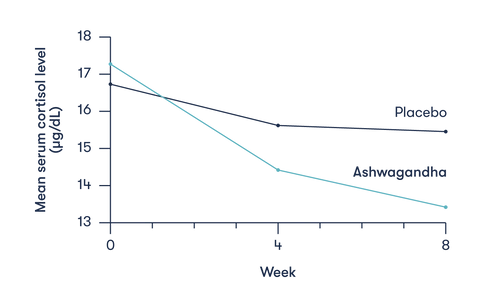
From: Choudhary et al., 2016
Ashwagandha & Sleep
Since stress has been linked to poor sleep quality, the herb’s antioxidative and cortisol-suppressant effects could be sufficient to explain this data. However, research has also proposed that ashwagandha has a profound effect on GABA, which is the brain’s primary inhibitory neurotransmitter, dampening signaling between neurons and facilitating a more relaxed physiological state. [4][5] In fact, one study in 2020 found that the herb improved sleep by 72% on average; however, it should be noted that this was a subjective scale, and studies measuring neurobiological or physiological markers of sleep improvement are lacking [6].
NOTE: These benefits were assessed after 6 weeks of use, so consistency is a large factor of observing similar effects.
Other benefits
Outside of the realm of sleep, anxiety, and stress benefits, further study is required in order to verify claims like improved cognition, memory, learning, athletic performance, and sex drive.
Protocol
1. Timing
The time of day ingested is a crucial factor to successful use of ashwagandha as an adaptogen: consider what Stanford neuroscientist Dr. Andrew Huberman proposes in “The Huberman Lab Podcast“.
“Cortisol peaking early in the day provides an anti inflammatory, immune supporting, focus and mood supporting effect all day long, so I would recommend that people take their first dose of ashwagandha anywhere from 250 to 300 mg sometime in the early afternoon and then again in the evening as opposed to taking a morning dose and an afternoon dose.”
Cortisol peaks early in the day are indeed a vital function of the sleep-wakefulness cycle, coordinating bright-light signals from the retina with the brain’s “master clock;” the suprachiasmatic nucleus (SCN), a region of the hypothalamus. The SCN sends this message of “time-of-day” to the immune system, which explains the anti-inflammatory and immune supporting benefits Dr. Huberman describes.
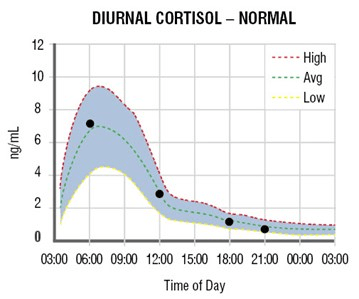
From: ZRT Lab
The red curve might represent diurnal (daily) cortisol levels normally, while the yellow curve would more accurately depict the result of stifling cortisol levels early in the morning.
2. Dosing
Dr. Huberman’s recommendation of 250-300mg is slightly less potent, but it is recommended to begin at lower doses and increase concentration as needed. The study cited here was concluded that 600mg doses were effective for anxiety reduction.
3. Form
Ashwagandha can be taken orally through powder, capsule, or raw extract. As long as you adhere the dosing prescribed above, the specific form should not matter. However, keep a lookout for our updated science-backed list of the best proven ashwagandha supplements, soon-to-come. Some companies like Nourished sell gummies with ashwagandha extract, along with a host of other natural sleep aids.
Side-Effects
You should not use Ashwagandha if you are one of the following:
- Pregnant women
- People with stomach ulcers
- Women who are breastfeeding
- People taking thyroid hormones


References
[1] Lopresti, A. L., Smith, S. J., Malvi, H., & Kodgule, R. (2019). An investigation into the stress-relieving and pharmacological actions of an ashwagandha (Withania somnifera) extract: A randomized, double-blind, placebo-controlled study. Medicine, 98(37), e17186. https://doi.org/10.1097/MD.0000000000017186
[2] Suganya, K., Kayalvizhi, E., Yuvaraj, R., Chandrasekar, M., Kavitha, U., & Konakanchi Suresh, K. (2020). Effect of Withania Somnifera on the antioxidant and neurotransmitter status in sleep deprivation induced Wistar rats. Bioinformation, 16(8), 631–637. https://doi.org/10.6026/97320630016631
[3] Kuchewar VV, Borkar MA, Nisargandha MA. Evaluation of antioxidant potential of Rasayana drugs in healthy human volunteers. Ayu. January 2014;35(1):46-49. Ashwagandha and Indian Tinospora Reduce Oxidative Stress in Healthy
Adults. https://www.herbalgram.org/resources/herbclip/issues/bin_519/111422-519/
[4] Langade, D., Kanchi, S., Salve, J., Debnath, K., & Ambegaokar, D. (2019). Efficacy and safety of ashwagandha (Withania somnifera) root extract in insomnia and anxiety: A double-blind, randomized, placebo-controlled study. Cureus, 11(9), e5797.https://pubmed.ncbi.nlm.nih.gov/31728244/
[5] Deshpande, A., Irani, N., Balkrishnan, R., & Benny, I. R. (2020). A randomized, double blind, placebo controlled study to evaluate the effects of ashwagandha (Withania somnifera) extract on sleep quality in healthy adults. Sleep Medicine, 72, 28–36.https://pubmed.ncbi.nlm.nih.gov/32540634/
[6] Mehla, J., Gupta, P., Pahuja, M., Diwan, D., & Diksha, D. (2020). Indian medicinal herbs and formulations for Alzheimer’s disease, from traditional knowledge to scientific assessment. Brain Sciences, 10(12), 964.https://pubmed.ncbi.nlm.nih.gov/33321899/

 The Neo-Neuron
Leave a comment