
A neuroscience-backed proposal for using yoga as therapy to treat developmental trauma and other impulsivity-deficit inducing experiences.
What is Trauma Sensitive Yoga (TSY)?
Trauma sensitive yoga is an adapted version of traditional yoga specifically for individuals affected by psychological trauma. The practice originated in 2001 and since has gained considerable popularity, but not enough to make it “mainstream” (1). The idea behind TSY is a form of physical self expression oriented more around the mind-body connection than any other spiritual or solely physical to help treat trauma patients. With an increased feeling of ownership over one’s body one can feel more focused, confident and empowered. TSY instructors will be more sensitive towards their patients by increasing the amount of predictability by counting down, by asking before touching any patient, and by using safer language.¹ You’d be surprised how much these seemingly insignificant changes influence the appeal of yoga to several people. It turns out, yoga can actually be pretty stressful in some environments, especially if it’s prescribed to you as a form of therapy. That’s where TSY comes into play. Studies have shown that yoga has short and long term effects on impulsivity in adolescents with a broad range of psychiatric conditions (2). It’s difficult to explain; instead, I’ll refer you to this video done by a TSY-certified instructor. Before we take a look at the science, let’s have a meaningful reflection on the importance of a proper treatment.
Background & Significance
Treating impulsivity is, obviously, a high priority for several reasons. Developmental trauma, especially in America, is soaring, and this is inducing devastating behavioral issues in many of the youth. If that’s not terrible enough by itself, this can contribute to crime rates and instability across the country. The economics of it all are pretty screwed up, too. Consider: most victims of childhood mistreatment and maltreatment can be up to $210,000. Society wide costs are as high as $124 billion (3).
But wait…let’s back up here. If we’re gonna figure out any degree of a solution, we need to define the problem well. What is impulsivity? Put simply, impulsivity can be characterized by urgency, quick reactions, and unpredictable actions without considering consequences (4). Some people consider it an escape mechanism from other negative ways of expressing emotion. Children exposed to traumatic childhood experiences are likely to develop impulsive characteristics. Long term, this will inevitably lead to bad mental health and other issues.
The Neuroscience
To simplify things a bit, a study that examined 14 10-13 year-old males with a spectrum of psychiatric conditions found that the practice of yoga significantly decreased the number of impulsive decisions made in the 8 and 24 hour periods that followed. Couple of points I’d like to make.
First, Yoga decreases activation of the sympathetic NS, while increasing activity in the parasympathetic NS, calming the brain, modulating the fight or flight response which is a key part of impulse.
The simplest way of explaining this is that the brain takes cues from the body, which means if the body is calm (a primary goal of TSY), then the brain follows suit.
Second, this notion of interoception is extremely important in trauma. This is an essential cognitive function that allows you to reflect on, well, your own internal state. Biologically, it involves your brain’s ability to sense internal signals in your body, like when your heart beats quickly or when you’re hungry.
Victims of developmental trauma suffer interoceptive deficit. This essentially means that they feel their self separate from their actions; they feel alienated from their own body. This lack of interoception is empirically linked to higher risk taking and generally rash behavior because these individuals cannot calculate consequences.
That’s where TSY comes in (or so, I think). TSY supposedly would aid this through raising bodily awareness and establishing a mind-body connection.
If you’re interested, here’s my theory (completely unproven, by the way): It involves (my favorite) brain structure: the insula. The insula is divided into three regions: dorsal anterior, ventral anterior, and posterior. The anterior insula has several interesting functions that I’ll save for another post (namely, emotional and cognitive functions important in substance abuse disorders and drug seeking behavior), but the posterior part is what I’m interested for our purpose. The posterior insula connects with sensorimotor integration areas; namely, the pre-motor and supplementary motor cortex. This basically just means that when you move, the insula knows about it. Not coincidentally, it is also considered the primary interoceptive cortex because it integrates these somatosensory details in order to produce various (often negative) states. It’s my speculation that yoga, through triggering various somatosensory areas, could upregulate (increase activity) in the posterior insula: this is what, supposedly, creates the “mind-body connection.” Through this mechanism, yoga might be able to increase interoception which decreases impulsivity through awareness, resolving impulsivity deficits that are so common.
An (Initial) Study Proposal
I’ll now propose a very rough plan for a 4 month study to prove TSY’s usefulness in impulsivity. I’ve presented a simplified diagram below. Don’t worry too much about ACE’s scale and Baratt’s test; those are just subjective experience markers and metrics of evaluation for impulsivity and past trauma.
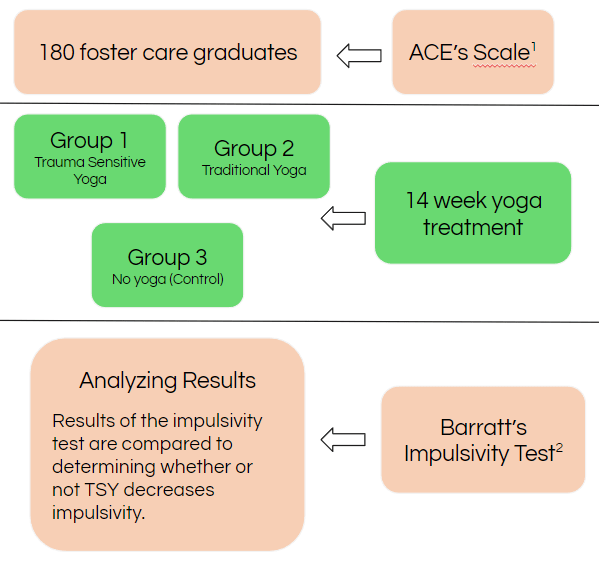
It seem simple enough. Obviously, I don’t have the resources right now to execute this (if you’d like to help, reach out). Yoga has been considered for psychological treatment before, but to my knowledge a study has not been conducted based on this type of yoga, which I sincerely believe could yield far more returns.
Further Considerations
There are a few things we ought to consider. First, we should be mindful; certain aspects of yoga could cause traumatic memories, such as certain positions, sensations, and touch, which causes a flight or fight response. This could cause premature dropout in participants and treatments being less effective. This also comes with some unable to express their trauma and experience verbally. With regular triggers being present, this can lead to a decrease in life quality. The next question is: will we have a responsibility to offer trauma sensitive yoga to those studied upon or to new patients? If effective, insurance coverage could influence the business model of yoga studios and thus access to yoga through excessive cost or inadequate insurance coverage.
There are certainly some gaps in the proposal, but they surely can be resolved with further planning and effort. TSY truly has the potential to treat impulsivity and access an unprecedented amount of people. If you have a computer and an internet connection, you could save thousands in therapy!
References
1. Capozzi, Brittany. “Is Trauma-Sensitive Yoga Right for Me? What It’s All About?” Step up for Mental Health, 7 Feb. 2021, http://www.stepupformentalhealth.org/ is-trauma-sensitive-yoga-right-for-me-what-its-all-about/.
2. Cara E. Petrofes, Crystal D. Oberle & Alexandra Middleton (2021) A Preliminary Study Investigating the Effects of Yoga Therapy on Impulsivity in Children Diagnosed with a Psychiatric Condition, Child & Family Behavior Therapy, 43:4, 278-286, DOI: 10.1080/07317107.2021.1965764
3. Liu, R. T. (2018). Childhood maltreatment and impulsivity: A meta-analysis and recommendations for future study. Journal of Abnormal Child Psychology, 47(2), 221-243. https://doi.org/10.1007/s10802-018-0445-3
4. Shin, S. H., McDonald, S. E., & Conley, D. (2018, November). Profiles of adverse childhood experiences and impulsivity. Science Direct. Retrieved July 14, 2022, from https://www.sciencedirect.com/science/article/pii/S0145213418303090
 The Neo-Neuron
Leave a comment