
You’re destroying your creativity, attention span, and humanity: lessons from the neuroscience of boredom.
Here’s what you think boredom is:
Humans problematize inoccupation when they assign the label “boredom” to their state of being.
Boredom is defined by Oxford Languages as
“feeling weary because one is unoccupied or lacks interest in one’s current activity.”
Weary is defined as
“feeling or showing tiredness, especially as a result of excessive exertion or lack of sleep.”
and also as
“reluctant to see or experience any more of; tired of.”
“calling for a great amount of energy or endurance; tiring and tedious.”
All three of these definitions of “boredom” are misleading and neuroscientifically inaccurate, as I am about to explain. But first, I will offer my own definition. From now on, whenever the word “boredom” is referred to in this article, we are discussing:
The state of intentional inoccupation
With this in mind, let’s continue. I’ll explain why I chose this wording later.
Electrocute yourself (metaphorically)
In this section, you will learn how to harness your biological disinclination to boredom and use it to complete difficult tasks you have been putting off.
A social psychologist by the name of Timothy Wilson placed participants alone in a room for a set amount of time [1]. In the room, he placed a button that, when pressed, electrocuted the participant (the participants were aware of the effect of this button, and some even said that they would pay money to avoid this electrocution). Surprisingly, with no external stimulus to occupy their mind, 67% of men and 25% of women chose to voluntarily shock themselves due to lack of another activity.
This offers a valuable insight into the importance of boredom. Wilson’s experiment suggests that bored people are much more likely to engage in tasks that they would normally be opposed to doing. If you force yourself into a state of “artificial boredom,” you might be able to complete a task that you had been putting off for a long time.
Lock yourself into a room without your phone, close unneeded tabs on your computer, and remember your objective is not to finish the task at hand, rather, to be bored. Sit around for a few minutes. You will inevitably resort to completing the task: that is the nature of the human brain. Activities that previously loathsome are now the most entertaining use of your time.
Boredom incites productive action. Boredom is a drive just like hunger or thirst, which are both important and uncomfortable. You can either satisfy your hunger with junk food, or you can satisfy it with a healthy, nutritious meal. Both actions will have consequences. Boredom is no different. Yes, boredom can be satisfied through modern attention-engineered entertainment like social media. However, living with your boredom can give rise to creative outbursts, similar to how a more healthy diet can generate energy and productivity.
Creativity and Boredom
Creativity likely can be thought of as a circuit with two main nodes: the prefrontal cortex and the default mode network. The default mode network is thought to play a large role in imagination and social cognition. Specifically, this is the part of the brain responsible for incorporating past experiences with future-oriented thinking to produce novel ideas. Feelings of boredom are linked to higher activation of the default mode network.
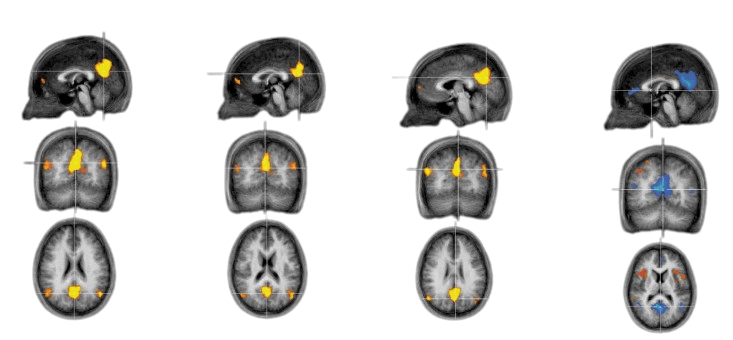
Resting State Boredom Sustained Attention Interest (Modified from Danckert and Merrifeld 2016)
“Regions of the posterior DMN consistently active in the resting state, boredom mood induction and sustained attention task are highlighted. The same regions were anticorrelated during the interest mood induction (see, Tables for full details). Clusters shown in warm colours reflected correlated activity, whereas clusters shown in cool colours represent anticorrelated activity” [2]
The default mode network (DMN) consists of mainly the medial prefrontal cortex, posterior cingulate cortex, and the inferior parietal lobule. The precuneus and middle temporal lobule are sometimes considered the DMN. Activation of this region during boredom, resting state, and sustained attention is “anticorrelated” with regions highlighted in blue during interest-engaging activities. These findings imply a tradeoff between engaging, high intensity activities and imaginative, creative brainstorming associated with the DMN. Thus, it is important to schedule set time periods during the day to brainstorm and create.
Remember: “il dolce far niente,” the sweetness of doing nothing, as they say in Italy. The neuroscience of boredom tells us that in reality, it isn’t something you should neglect. Boredom could be the key to unlocking your creative genius.
References
[1] Wilson, T. D., Reinhard, D. A., Westgate, E. C., Gilbert, D. T., Ellerbeck, N., Hahn, C., Brown, C. L., & Shaked, A. (2014). Social psychology. Just think: the challenges of the disengaged mind. Science (New York, N.Y.), 345(6192), 75–77. https://doi.org/10.1126/science.1250830
[2] Danckert J, Merrifield C. Boredom, sustained attention and the default mode network. Exp Brain Res. 2018 Sep;236(9):2507-2518. doi: 10.1007/s00221-016-4617-5. Epub 2016 Mar 15. PMID: 26979438.
 The Neo-Neuron
Leave a comment